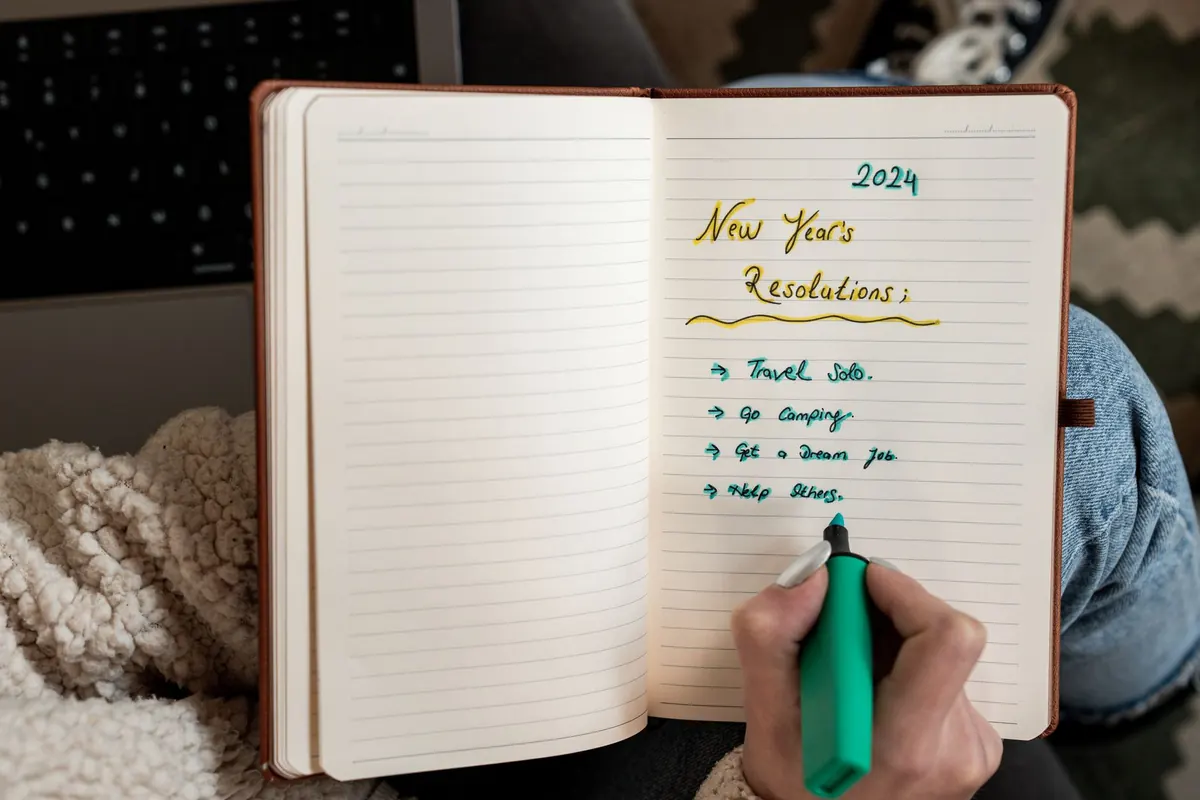
January has a particular quality. The decorations are down, the fridge is back to normal, and the year stretches ahead with very little in it yet. It is tempting to mark that blank space with a list of resolutions — and equally tempting to abandon that list by the second week.
A journaling reset works differently. Instead of promising to become a new person, you spend an hour or two reading the year you have just finished and deciding, on paper, what deserves to carry over. Here are five prompts to work through, plus a straightforward way to turn the answers into plans you might actually keep.
Start With the Year You Actually Had
Before any forward planning, gather evidence. Memory is a poor record keeper: it holds on to the dramatic and quietly loses the ordinary. Collect a few things and put them next to your notebook:
- Your diary or calendar from the past twelve months
- A bank or card statement from two ordinary months
- Photos on your phone, browsed month by month
- Any notes, lists or half-finished journals already lying around
You are not auditing yourself for mistakes. You are looking for patterns: which weeks felt crowded, which commitments repeated themselves, where time and money went without you noticing.
Then set a timer for twenty minutes, put your phone in another room, and take one prompt at a time. Keep writing past the first easy answer. The useful sentences usually turn up second.
The Five Prompts
1. Where did the time actually go?
Write out a typical week in January and a typical week in July, then compare the two. Which activities appear in both? Which were seasonal? Finish with one question: if I could take back three hours a week, where would they come from?
That is far more productive than asking how to be more productive. It points at specific things — a commute, a group chat, a subscription you forgot about, the habit of saying yes on Thursday evenings.
2. What did I finish, and what did I quietly abandon?
Make two columns. On the left, things completed, however small. On the right, things that drifted. Then ask of each abandoned item: did I choose to stop, or did it simply fade?
Deliberate stopping is fine and worth noticing. Drifting is worth noticing too. If four projects faded at the same stage, the trouble is probably the stage, not your willpower.
3. When did I feel most like myself?
Think of five or six moments from the year when you felt settled, interested, useful or calm. Describe each in two or three sentences. Then underline the ingredients they share: certain people, a place, a type of work, a time of day, a level of quiet.
This is the most reliable guide you have to what to say yes to next. Most of us plan by ambition. It is more accurate to plan by evidence.
4. What do I want less of?
Subtraction first. Additions tend to fail when the week is already full. Write a short "less" list: fewer evening meetings, fewer notifications, fewer open obligations you never agreed to properly.
A "less" list turns into a vague resolution if you don't attach it to something concrete. "Less scrolling" is a wish. "Phone charges in the kitchen overnight" is a decision.
5. What do I want to be true by next December?
One sentence only. Not five. Something you can check in a year without arguing about definitions:
By next December, I want to be able to say that I…
Underneath it, write the smallest first step — something you could do this week in under twenty minutes. One step is enough. You are setting a direction, not a schedule.
If the year ahead involves money decisions, health concerns or anything legal, treat the journal as thinking space rather than advice. Speak to a qualified professional — an adviser, a GP, a solicitor — before acting on it.
Turning Five Pages Into a Plan You Will Keep
Now edit. Read back through everything you wrote and pull out three short lists:
- Keep — the things that worked and deserve more room
- Start — one or two new commitments, no more
- Stop — what you are dropping, and the practical way you will drop it
Keep the whole plan to a single page. Put it somewhere you will meet it in March, not only in January: inside the front cover of your diary, or pinned above the desk where you work. A plan you can see in ten seconds gets used. A plan in a document you have to open does not.
Then swap the rigid timetable for a monthly check-in. First Sunday of the month, fifteen minutes, read the page, adjust a line or two. A year is long and your circumstances will shift. A page you revisit twelve times will beat a plan you make once and file away.
Keep the Reset Small
The point of a January reset is not to produce a perfect plan. It is to start the year with a decision rather than a habit. If you only have twenty minutes, do prompt three and prompt five — what felt right, and what you want to be true. Those two answers will carry you well into spring.
And leave the notebook out on the table. A journal opened four times a year is still a useful thing, especially in a month when the evenings are long and there is not much to do but think.
Photo: Ahmed / Pexels